UPDATES:- 27 Sep. 2026 Developing an improved, but unofficial training program for CFA VIctoria radio operators
A collection of current projects, relating both to information and training, but also several that meet a specific need that became obvious after many years as a
member of various Victorian CFA Brigades.
member of various Victorian CFA Brigades.
UNOFFICIAL CFA RURAL BRIGADE RADIO OPERATORS TRAINING COURSE
This folder contains an unique training course in CFA radio operating procedures produced by the author (Peter Ward) of Flaggy Creek ‘Brigade, East Gippsland, to improve member radio operating skills and extend them to better handle fireground control point radio traffic.
1. Course aim and trainer setup is covered in the “BRIGADE RADIO TRAINING INTRODUCTORY NOTES.pdf”.
2. The file “RADIO COMMS TRAINING SLIDE SET R1.pdf” has the actual training material.
3. The COMMS PROGRAM INFO and TRAINER PACK R1.pdf contains matching page by page instruction outlining slide aims, and script cards to practice the teaching on selected slides.
This course is not issued, supported, or recommended by the Victorian CFA.
If this does not improve on anything currently available in official training documents let me know how to improve it.
1. Course aim and trainer setup is covered in the “BRIGADE RADIO TRAINING INTRODUCTORY NOTES.pdf”.
2. The file “RADIO COMMS TRAINING SLIDE SET R1.pdf” has the actual training material.
3. The COMMS PROGRAM INFO and TRAINER PACK R1.pdf contains matching page by page instruction outlining slide aims, and script cards to practice the teaching on selected slides.
This course is not issued, supported, or recommended by the Victorian CFA.
If this does not improve on anything currently available in official training documents let me know how to improve it.
Project: To develop a training module, superior to any existing official CFA offering, covering radio procedure and management. (This course is not issued, supplied, reviewed, or recommended by the Victorian CFA. It was initially put together to assist local training, but others may see it as useful. It is released here for comment, and your feedback would be greatly appreciated.)
Your author simply claims, “more comprehensive, and with with a structured methodology than surpasses anything so far available in any official training documents” It deliberately embraces a clear and simple style that recognises we now have many recruits with no technical skills and who have absolutely no knowledge of the fireground.
Download the existing approved "Radio Communications.pptx" from the CFA training library and compare the two.
Your author simply claims, “more comprehensive, and with with a structured methodology than surpasses anything so far available in any official training documents” It deliberately embraces a clear and simple style that recognises we now have many recruits with no technical skills and who have absolutely no knowledge of the fireground.
Download the existing approved "Radio Communications.pptx" from the CFA training library and compare the two.
A TRAINING COURSE FOR VICTORIAN CFA RURAL BRIGADE RADIO OPERATORS (NO OFFICIAL APPROVAL)
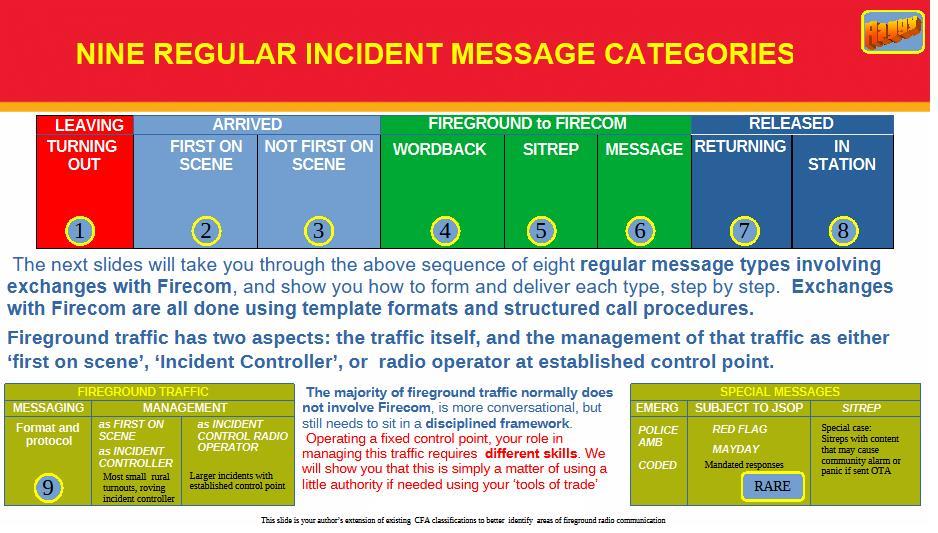
Above: Example slide: Slide four above indicates the structured nature of the radio operator's training course, shows a careful differention of
operational traffic types. Wordback, sitrep and other categories are all given individual slides ensuring all are formed and delivered correctly.
operational traffic types. Wordback, sitrep and other categories are all given individual slides ensuring all are formed and delivered correctly.
About your program author, and a touch of history upholding our early poineers in CFA radio.
Your author's journey through the CFA began in 1960, at age 18, at Mt Martha (with its sea of houses located among ti-tree slopes requiring quick, decisive responses), and has continued with minor breaks over sixty-six years, the past forty eight years being at Flaggy Creek. It was at Mt Martha CFA Brigade, under the ‘spell’ of the legendary Bill Jones1 of Moorooduc, who partnered with the Gibson brothers of Hastings to first introduce radio to Victorian fire fighting vehicles, that his interest in fireground communications was fostered, and still remains. This course could be considered an extension of Bill's influence, and as such, a small tribute to the great vision of a few at a time when progress was achieved by personal effort, and not simply a matter of wording a 'grant'
The Mt Martha CFA Brigade truck radio was a type ‘FS6’ a model which first saw service with the Australian military in the 1930s. These radios were converted locally for ‘crystal’ control, and for use at a frequency for which they were not designed, under guidance of Bill Gaull.2 The FS6 was huge, heavy, and fragile. As well, it had a separate large power supply. Both units sat on the floor of the Chev. “4x4 Blitz’. Never designed to sustain such vibration arising from such a mount, valves often needed replacing. The antenna was originally rear of cab mounted and large when compared with modern VHF antennas. The radio had to be carefully adjusted to ‘match’ the antenna to avoid destroying the output valve, and to ensure optimal transmit and receive power. These adjustment knobs were easily knocked, and had to be re-adjusted with an eye on the power output meter.
From the author’s memory, ‘VL30F base station’ at Moorooduc used an ex R.A.A.F type T1154 transmitter, but this may need verifying. Bill ran a weekly radio check for us every Sunday morning. In particular, the continuous monitoring of all our communications by the Postmaster General’s Radio Monitoring Division located at Werribee ensured that correct use, adherence to licence conditions (including regular ‘frequency checks’), and correct use of a basic skill set became ingrained.
The Captain’s kitchen table radio was an ex. RAAF type ATR-2B. These already had provision for the mandated crystal control, but had to be converted to range down to a frequency they were not built for. They also needed the antenna tuning knobs to be carefully adjusted.
Efficiency of these 8 watt output radios at this low freuency was such that whilst living at Litchfield (between Donald and Warracknabeal), your author was able to send Bill a ‘QSL’ card, having read his Sunday morning ‘sked’ clearly, as well as the acknowledgement returned by most of the responding trucks.
In the days before the CFA map books, the region was referenced using a Shire map, ruled into small numbered squares. Turnouts were directed to a numbered square.
During time at ‘Flaggy', Peter was Bairnsdale Group ‘Comms Officer’ for four years of elected terms, plus an earlier eight months taken on when the elected Officer 'quit'. This was the earlier, localised role that preceded ‘Vicfire’ and 'Firecom', and in many ways exceeded its current duties, being effectively at times, ‘Firecom on steroids’.
During his career as an educator, he authored and won two heavily contested state wide “Victorian Curriculum Excellence Awards” (1990, 2006), both being related to curriculum leadership and innovation.
As one of the oldest remaining active CFA members to have a close knowledge of those pioneering times, I place this small effort into the public domain to remind of, and continue a work these visionaries put so much effort into.
1. In the late 1950s Bill Jones of the Moorooduc Brigade had assembled a base station in a tiny shack beside his engineering business. An ex. RAAF transmitter and receiver were used, the transmitter having been converted locally to suit our lower frequency, and given ‘crystal control’ to give frequency stability needed for the station licence. Assigned call-sign was ‘VL30F’, and radios used amplitude modulation at a frequency of 2740 kilocycles. (Hastings Brigade history calls these VHF radios, and this appears in error, as this earliest allocation is in the HF band.)
2. Bill Gaul's name appears in no history, but his skills enabled the introduction of radios to CFA trucks at this time using military surplus. The Postmaster General had set very strict requirements on frequency stability."crystals" had to be found, re-tuned if needed, and radios adapted to their use.
Your author's journey through the CFA began in 1960, at age 18, at Mt Martha (with its sea of houses located among ti-tree slopes requiring quick, decisive responses), and has continued with minor breaks over sixty-six years, the past forty eight years being at Flaggy Creek. It was at Mt Martha CFA Brigade, under the ‘spell’ of the legendary Bill Jones1 of Moorooduc, who partnered with the Gibson brothers of Hastings to first introduce radio to Victorian fire fighting vehicles, that his interest in fireground communications was fostered, and still remains. This course could be considered an extension of Bill's influence, and as such, a small tribute to the great vision of a few at a time when progress was achieved by personal effort, and not simply a matter of wording a 'grant'
The Mt Martha CFA Brigade truck radio was a type ‘FS6’ a model which first saw service with the Australian military in the 1930s. These radios were converted locally for ‘crystal’ control, and for use at a frequency for which they were not designed, under guidance of Bill Gaull.2 The FS6 was huge, heavy, and fragile. As well, it had a separate large power supply. Both units sat on the floor of the Chev. “4x4 Blitz’. Never designed to sustain such vibration arising from such a mount, valves often needed replacing. The antenna was originally rear of cab mounted and large when compared with modern VHF antennas. The radio had to be carefully adjusted to ‘match’ the antenna to avoid destroying the output valve, and to ensure optimal transmit and receive power. These adjustment knobs were easily knocked, and had to be re-adjusted with an eye on the power output meter.
From the author’s memory, ‘VL30F base station’ at Moorooduc used an ex R.A.A.F type T1154 transmitter, but this may need verifying. Bill ran a weekly radio check for us every Sunday morning. In particular, the continuous monitoring of all our communications by the Postmaster General’s Radio Monitoring Division located at Werribee ensured that correct use, adherence to licence conditions (including regular ‘frequency checks’), and correct use of a basic skill set became ingrained.
The Captain’s kitchen table radio was an ex. RAAF type ATR-2B. These already had provision for the mandated crystal control, but had to be converted to range down to a frequency they were not built for. They also needed the antenna tuning knobs to be carefully adjusted.
Efficiency of these 8 watt output radios at this low freuency was such that whilst living at Litchfield (between Donald and Warracknabeal), your author was able to send Bill a ‘QSL’ card, having read his Sunday morning ‘sked’ clearly, as well as the acknowledgement returned by most of the responding trucks.
In the days before the CFA map books, the region was referenced using a Shire map, ruled into small numbered squares. Turnouts were directed to a numbered square.
During time at ‘Flaggy', Peter was Bairnsdale Group ‘Comms Officer’ for four years of elected terms, plus an earlier eight months taken on when the elected Officer 'quit'. This was the earlier, localised role that preceded ‘Vicfire’ and 'Firecom', and in many ways exceeded its current duties, being effectively at times, ‘Firecom on steroids’.
During his career as an educator, he authored and won two heavily contested state wide “Victorian Curriculum Excellence Awards” (1990, 2006), both being related to curriculum leadership and innovation.
As one of the oldest remaining active CFA members to have a close knowledge of those pioneering times, I place this small effort into the public domain to remind of, and continue a work these visionaries put so much effort into.
1. In the late 1950s Bill Jones of the Moorooduc Brigade had assembled a base station in a tiny shack beside his engineering business. An ex. RAAF transmitter and receiver were used, the transmitter having been converted locally to suit our lower frequency, and given ‘crystal control’ to give frequency stability needed for the station licence. Assigned call-sign was ‘VL30F’, and radios used amplitude modulation at a frequency of 2740 kilocycles. (Hastings Brigade history calls these VHF radios, and this appears in error, as this earliest allocation is in the HF band.)
2. Bill Gaul's name appears in no history, but his skills enabled the introduction of radios to CFA trucks at this time using military surplus. The Postmaster General had set very strict requirements on frequency stability."crystals" had to be found, re-tuned if needed, and radios adapted to their use.
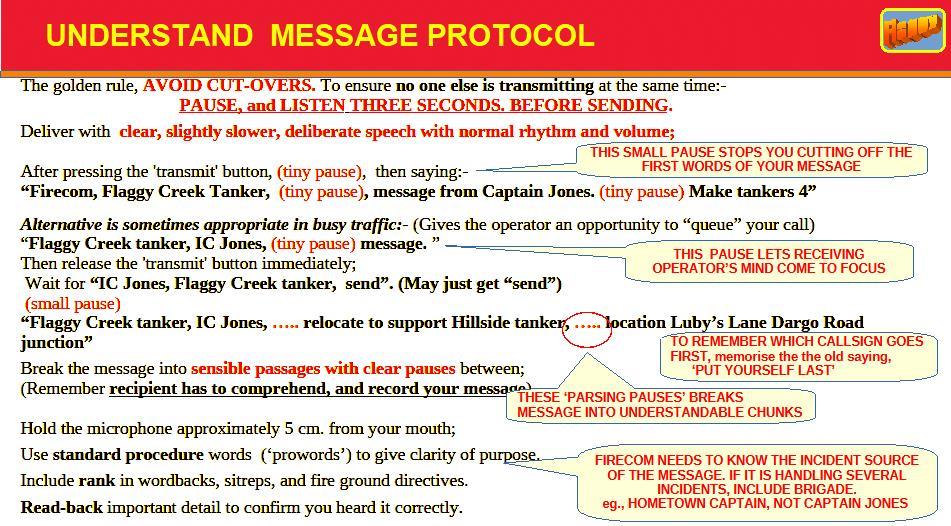
Above: Example slide showing how message delivery skills require breathing and 'chunking' skills: Each slide is supported by trainer notes, and some include scripts for trainee to read. They are all based on official documentation and JSOPs

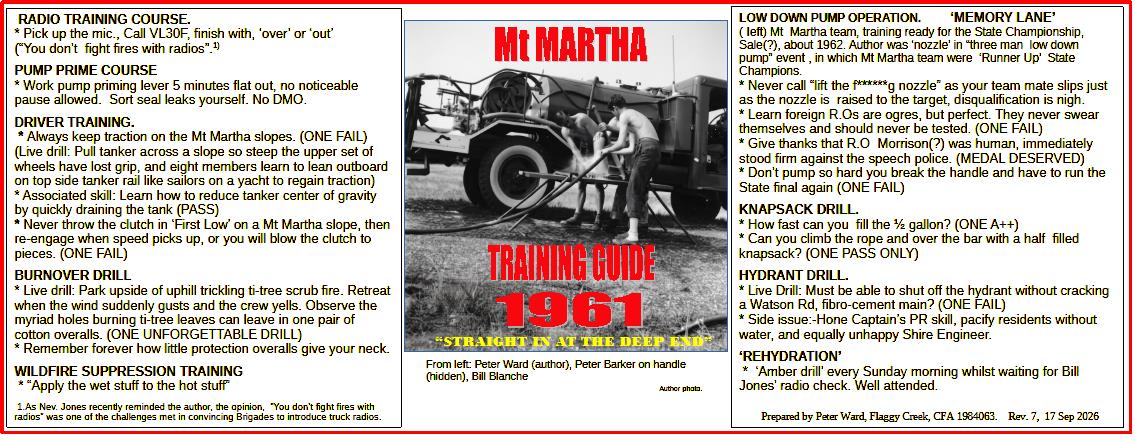
Author summarises training syllabus at Mt Martha CFA Brigade in the early 1960s
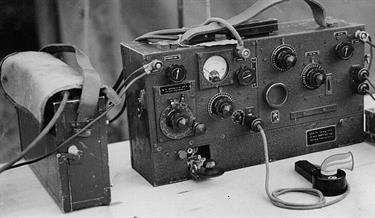
Above:-An ex military radio type ‘FS6’ sat on the floor of Mt Matha's fire truck, an ex-army 4x4 Chev 'Blitz'
https://hmvf.co.uk/topic/46482-australian-wireless-pics/
Left:- The antenna sat originally high behind cab, Moved later to bull bar, indicating that in first installations, vunerability had not yet been fully appreciated.
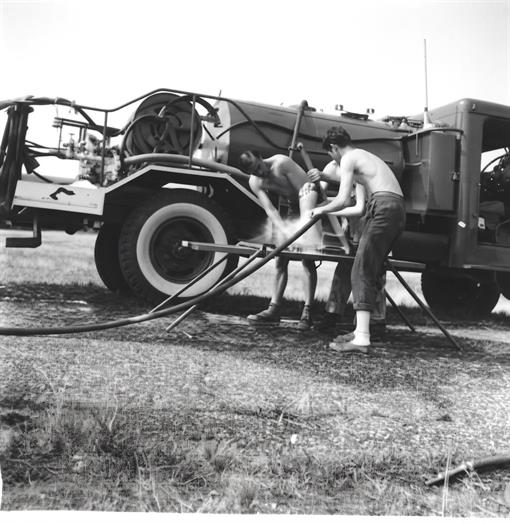
From left: author, Peter Ward, center (on handle but obscured) Peter Barker, Bill Blanche.
Incidentally, Peter Barker, on the pump handle was of exceptional strength, broke the pump handle at our run in the State Championship final. Later, Peter went on to become Mt Martha Captain.
(A re-run was granted, but we lost as your author slipped at the critical moment, sliding well under the target.) (Author photo)
https://hmvf.co.uk/topic/46482-australian-wireless-pics/
Left:- The antenna sat originally high behind cab, Moved later to bull bar, indicating that in first installations, vunerability had not yet been fully appreciated.
From left: author, Peter Ward, center (on handle but obscured) Peter Barker, Bill Blanche.
Incidentally, Peter Barker, on the pump handle was of exceptional strength, broke the pump handle at our run in the State Championship final. Later, Peter went on to become Mt Martha Captain.
(A re-run was granted, but we lost as your author slipped at the critical moment, sliding well under the target.) (Author photo)
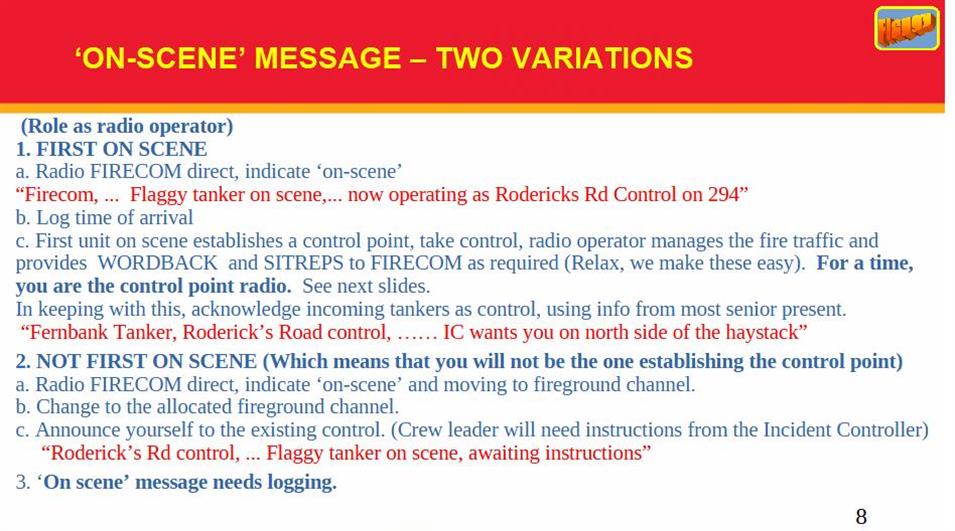
Above: Example slide makes clear the differentiation of 'on scene' messages. Our aim is for all slides to simply and clearly define the tasks of a radio operator, and to follow this slide we make it clear that content of Wordback and Sitrep are provided by incident controller, and that the radio operator would only have to assemble and send information collected.
Above: Brigade training at Mt Martha in the 1960s was a more casual business, and as the slide above indicates, could be considered "straight in at the deep end", with most skills learned "on the slopes"